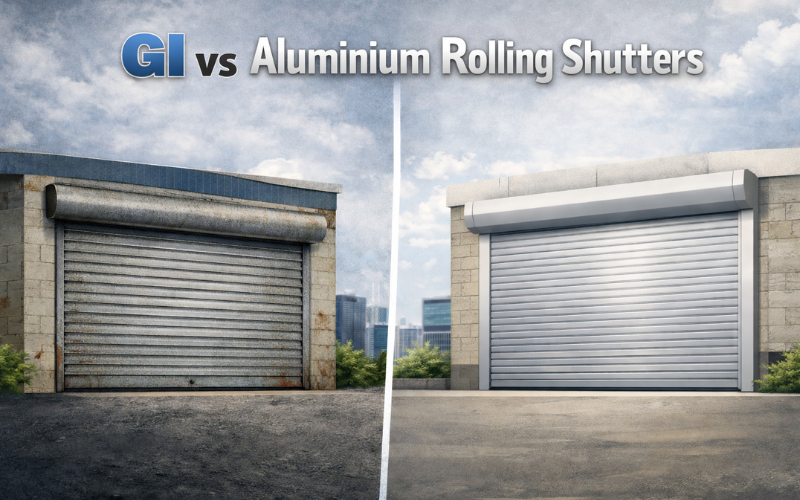
Rolling shutters are widely used for securing entrances in commercial and industrial properties. When selecting a rolling shutter system, one of the most important decisions is choosing the right material.
Two of the most common materials used in shutter manufacturing are GI (Galvanized Iron) and Aluminium. Both materials offer unique advantages, and the choice depends on factors such as security requirements, environment, and budget.
Understanding the differences between GI and aluminium rolling shutters can help property owners select the most suitable option for their application.
GI rolling shutters are made from galvanized iron steel sheets coated with zinc to protect against corrosion. These shutters are known for their strength and durability.
Aluminium rolling shutters are made from lightweight aluminium slats that offer corrosion resistance and smooth operation.
GI shutters are stronger and more suitable for heavy industrial environments.
Aluminium shutters are lighter and easier to operate.
Aluminium naturally resists corrosion, while GI shutters rely on protective coatings.
GI shutters provide higher security due to their heavier construction.
Aluminium shutters are generally more expensive compared to GI shutters.
The choice between GI and aluminium rolling shutters depends on the application:
At Shri Ambika Manufacturing Co., we manufacture both GI and aluminium rolling shutters designed to meet different industrial and commercial requirements.
Our rolling shutter solutions are engineered for:
We work closely with builders, architects, and industrial clients to provide customized shutter systems for various applications.
Both GI and aluminium rolling shutters offer excellent security and functionality. Choosing the right material depends on the specific requirements of the property, including strength, durability, and design preferences.
Selecting the right shutter ensures better protection, efficient operation, and long-term reliability for commercial and industrial spaces.